Call Us Now: 818-881-7337

Treating the internal parts can maintain and provide a healthy and beautiful smile.
- Dr. Richard Benveniste


Laser Surgery

TMJ Therapy
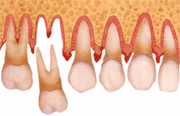
Periodontal disease is caused by plaque that forms from bacteria on the teeth.
Over time, it hardens into calculus, or tartar, that can begin to destroy the gum
tissue and eventually cause tooth loss.
Gum disease is the 2nd most common disease in the
world, 3 out of 4 adults suffer from some stage of gum disease, often without
realizing it.
Common symptoms are bad breath, bleeding when
brushing or flossing, red swollen gums, and a
change in bite or the fit of dentures.
Dr. Benveniste offers several treatment options to help
reverse the effects of gum disease.
Laser Surgery
Disfigured gums can be recontoured using advanced laser techniques. When indicated, this surgical method can remove diseased tissues with a precision unmatched by conventional techniques.
Scaling & Root Planing Scaling
Scaling is a technique which removes calculus deposits from your teeth. Root surfaces are then carefully smoothed to allow the gum tissue to reattach to the tooth.
Curettage
By removing the soft tissue lining the periodontal pocket, the gum tissue is allowed to heal.
Gum Recontouring
When the disease has not affected the jaw bone, Dr. Benveniste can recontour malformed, unattractive gums to a more natural appearance.
Flap Surgery
By pulling the gum flap back, calculus, plaque and diseased tissue can be removed from the root of the tooth, thereby preserving as much of the gum coverage as possible.
Osseus Surgery
Often used in conjunction with Flap Surgery, this procedure restructures the bone surrounding the tooth.
Bone Replacement Surgery
Most gum problems are a result of underlying bone loss. This procedure actually restores lost bone to prevent tooth loss, removes draining infection, and strengthens the patients chewing ability.
Dr. Benveniste aims to preserve and restore much of
the mouths natural appearance and function.

Bite & Surgical Correction

Pain Relief & Relaxtion Therapy
When the chewing muscles and the joint connected to the lower
jaw don't function properly, muscle spasms, pain and tissue
damage can result. Improper bite, arthritis, injuries, and
grinding and clenching are common causes of
Temporomandibular Joint Syndrome (TMJ).
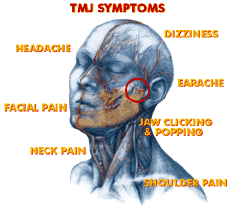
If you're experiencing headaches, jaw tenderness, locked jaws,
earaches, face pain, difficulty chewing, dizziness or clicking, popping
and grating sounds when opening or closing the mouth, you may
suffer from TMJ.
Once a thorough diagnosis is made,
Dr. Benveniste can provide several
conservative treatment options designed to
improve the function of joint muscles.
Bite Correction
Grinding and clenching the teeth while sleeping can not only cause irreversible damage, but is one of the most common causes of TMJ. Made from a mold of your teeth, a corrective bite plate or splint can be worn at night to reduce stress on the teeth and jaw. By relieving stress on the teeth and offering a protective barrier, it helps prevent the grinding and clenching that can lead to muscle spasms, and ultimately to jaw joint deterioration.
Dr. Benveniste may also recommend smoothing down misaligned teeth that are too high to prevent abnormal stress on the chewing muscles. This is typically painless and requires only one appointment.
Pain Relief
To relieve pain and muscle spasms, Dr. Benveniste may recommend ultrasound, moist heat packs, muscle massage and switching to a soft, non-chewy diet. Occasionally muscle relaxant and pain medication are prescribed.
Relaxation Therapy
Biofeedback and stress control techniques may be utilized to reduce muscle tension in the jaws.
Surgical Correction
When other methods of relief have proved insufficient, the joint itself is injured or arthritic, or when muscle spasms have occurred for long periods of time, surgery may be recommended.
If you're experiencing any symptoms of Gum Disease, or TMJ,
call (818) 881-7337 for more information or to schedule an appointment.